-
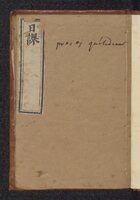 Preces quotidianae Sinica Lingua conscripta: in 8° X.(7)12
 Prayers
-
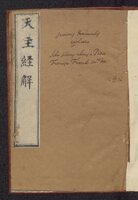 Furtadus Franciscus. “Explicatio oriationis Domicalis” Sinice, in 4°, X.(7).9.
 Prayers' explications
-
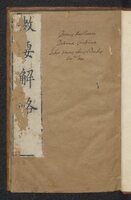 Declaratio brevis Doctrinae Xtiane: liber Sinicus editus a PP.Soc. Jesu To. in 4° X.(7).45.
 Summary explanation of the ‘Doctrina Christiana’, catechism introducing the Ten Commandaments
-
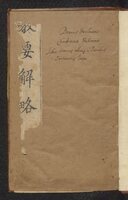 Declaratio brevis Doctrinae Xtiane: liber Sinicus editus a PP.Soc. Jesu To. in 4° X.(7).45.
 Summary explanation of the ‘Doctrina Christiana’, introducing the Ten Commandaments
-
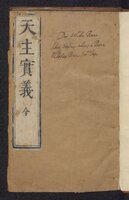 Riccius Mattheus “Dei solida ratio” Sinice. In 4°. X.(9).19
-
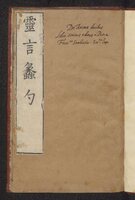 Sanbiasius Franciscus. “De Animae Dotibus”. Sinice in 4°. X.(7.)7.
 The work follows Aristotle’s theory of the three types of souls—the vegetative soul, the sensitive soul of animals, and the rational soul of humans—while integrating Augustine’s theory of the three functions of the soul. It argues that the study of the soul is the most beneficial and significant discipline in philosophy, with the purpose of knowing oneself and recognizing one’s origin, ultimately leading to the worship of God and the salvation of the soul. The book also incorporates Confucian thought into soul theory, using it to understand worldly affairs and, by extension, to cultivate the family, govern the state, and bring peace to the world.
-
 Directory to attain true happiness
 The first chapter focuses on the source of happiness, found in the observance of the Commandments and the practice of virtues. The second chapter introduces creation, salvation, the sacraments, the precepts of the Church, and the capital sins.
-
 Rogerius Michael “Dei solida Ratio” ac Discursus Sinicus, in 4° X.(7.)20.
-
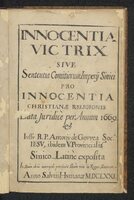 Innocentia Victrix, sive Sententia Comitiorum Imperii Sinici pro Innocentia Xtiane Religionis lata juridice anno 1669. Latine, et Sinice. Quàm Cheu, 1671, in 4°
 The Trial and Acquittal of Jesuit Missionaries in 1669; inside, the copy of the imperial edict of the Emperor Kangxi recording official tolerance of the Christian religion; astronomical observations and calculations made by the Jesuit fathers at their observatory in Peking. Antonio de Gouvea formally as the editor, the Portuguese vice-provincial, but probably responsible of this edition Andrea Giovanni Lubelli or François de Rougemont.
-
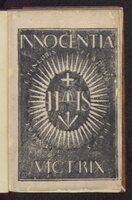 Innocentia Victrix, sive Sententia Comitiorum Imperii Sinici pro Innocentia Xtiane Religionis lata juridice anno 1669. Latine, et Sinice. Quàm Cheu, 1671, in 4°
 The Trial and Acquittal of Jesuit Missionaries in 1669; inside, the copy of the imperial edict of the Emperor Kangxi recording official tolerance of the Christian religion; astronomical observations and calculations made by the Jesuit fathers at their observatory in Peking. Antonio de Gouvea formally as the editor, the Portuguese vice-provincial, but probably responsible of this edition Andrea Giovanni Lubelli or François de Rougemont.
-
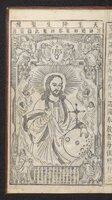 Imagines exprimentes vitam, et mortem Xti Dni cum declarationibus sinicis, in 4°, X. (7.)
 Illustrated Catechism on the Life of Jesus, inspired by Jerónimo Nadal 's "Evangelicae Historiae Imagines" (Images Of The Evangelical Gospels, 1593)
-
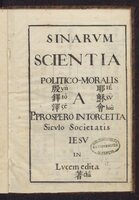 Intorcetta Prosper: Scientia Sinarum Politico Moralis Latine, et Sinice Goa 1669, in 4° X. (7.)3
 A short preface by Intorcetta, a Chinese-to-Latin translation of the Zhongyong 中庸 (54 pages), and an eight-page biography of Confucius
-
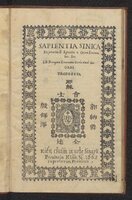 Costa Ignatius. Sapientia Sinica Orbi proposita a Prospero Intorcetta. Latine et Sinice. Kien Cam 1662. In 4° X.(7.)14
 A Latin translation of the Daxue 大學 and part of the Analects Lunyu 論語 (first five books)
-
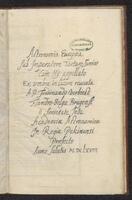 Astronomia Europea sub Imperatore Tartaro Sinico Cam Ky. 1668. Fol. X.(7.)3.
 European Astronomy studies at the Chinese Imperial Court